A pneumatic tool is only as dependable as the air reaching its inlet: too little flow slows production, while pressure losses, leaks and moisture waste energy. By the end, you will be able to match tool demand with delivered compressor capacity, protect pressure at the point of use and decide which compressor arrangement suits your operating pattern.
Key takeaways
- Size compressors by delivered air capacity, not horsepower alone.
- Check pressure at the tool, not only at the compressor outlet.
- Use filters, dryers, and regulators to protect tools and products.
- Match compressor controls to the workload’s duty cycle.
How compressed air drives pneumatic tools
Compressed air produces useful work by converting stored pressure into motion. When air enters a tool, it pushes a piston, rotates a vane motor, or opens and closes an actuator. The exhaust air then leaves through the tool, so the compressor must continuously replace the volume consumed.
Different pneumatic tools place different demands on the supply because they use air at different flow rates, pressures and duty cycles:
- Impact wrenches, nailers, riveters and clamps usually draw high flow in short bursts. A receiver can cover these brief peaks while the compressor recovers.
- Air drills consume air while the trigger is held, so drilling duration and bit load affect demand.
- Grinders and die grinders run continuously during a pass. Their sustained airflow can exceed the average demand of several intermittent tools.
- Spray guns need a steady, clean flow to maintain an even fan; pressure fluctuations produce uneven coating and overspray.
Do not compare a tool’s consumption in litres per minute or cubic feet per minute directly with motor horsepower. Compare the tool’s required flow and pressure with the compressor’s free-air delivery, or FAD, stated at a reference condition, discharge pressure and test method.
ISO 1217 test data makes that comparison more meaningful; two compressors with the same horsepower can deliver different usable airflow. Include only tools operating together, then account for leakage, pressure drop and the required reserve.
Size the compressor by delivered air, not horsepower
Add the air each tool will draw during the same work interval, not the horsepower of its motor. Convert every tool’s consumption to one unit—litres per minute or cubic feet per minute—and use the value at the required working pressure.
- Identify the simultaneous tool demand from your production schedule. Count only tools that operate together, applying a duty factor to intermittent tools such as impact wrenches.
- Add the running consumption of those tools.
- Add measured or estimated air leakage, plus fixed plant loads such as blowoff and a dryer’s purge air.
- Allow for pressure drop through filters, dryers, regulators, hose, couplings and piping.
- Compare the resulting flow with the compressor’s free-air delivery at the same discharge pressure and reference condition.
The compressor’s FAD rating is the useful comparison; horsepower alone is not. Ask for test data based on ISO 1217 acceptance-test methods, because two compressors with identical motor ratings can deliver different airflow. Do not add every tool’s maximum catalogue figure unless your process genuinely runs them all together.
A receiver can cover a short demand peak and reduce pressure swings, but it cannot replace inadequate continuous FAD. If the tool still falls below its required pressure, find the restriction rather than raising the whole system set point. Higher pressure increases energy use, leakage and unregulated blowoff.
Keep usable pressure stable from the receiver to the tool
Tank pressure is the air stored in the receiver tank; working pressure is the regulated setpoint supplied to a circuit; pressure available at the tool is the pressure remaining while the tool is consuming air. The last value is the one that determines performance.
| Measurement | What it means | Why it matters |
|---|---|---|
| Tank pressure | Pressure inside the receiver tank, which rises and falls with compressor operation | Shows stored reserve, not tool performance |
| Working pressure | Regulator or system pressure selected for the application | Sets the intended operating level |
| Pressure available at the tool | Pressure measured at the tool inlet during use | Reveals pressure lost in distribution |
A receiver tank absorbs short demand peaks, reduces pressure swing and gives compressor controls time to respond. It also reduces rapid motor cycling, but it cannot replace compressor capacity when demand stays high. Size it for peak flow, peak duration, allowable pressure swing and the compressor’s control method.
Measure pressure while the tool runs. Filters and regulators, hose and quick couplings, dryers and restrictive piping can consume the margin between working pressure and tool pressure. Keep generation-to-use pressure drop near or below 10% of compressor discharge pressure; raising the whole plant set point wastes energy and can increase leakage.
For a distant, intermittent tool, a local receiver near the point of use can supply a short burst without forcing the entire distribution system to operate at higher pressure.
Use compressed air beyond tool driving—and clean safely
Compressed air moves product and machine parts through conveying lines, and it provides force for clamping and actuating cylinders. Instrumentation and control systems also use treated air to operate valves and positioners; moisture or oil in that air can make a control valve stick or damage a sensor.
Specify air by ISO 8573-1 air quality classes, which rate particles, water and oil separately. A tool may tolerate filtered air that would be unsuitable for paint, food contact, instrumentation or breathing air, so select the filtration, dryer and monitoring system for the actual application.
Treat blow-off as a measured process, not a free cleaning utility. An open pipe wastes air and creates noise; low-consumption nozzles, local regulators and short hoses deliver the required force with less demand. Use electric blowers for continuous, high-volume cleaning when their airflow suits the task better than compressed air.
For safe cleaning, follow this checklist:
- Keep nozzle pressure below the OSHA 30 psi cleaning limit and install effective chip guarding.
- Wear eye protection; debris projection can cause eye injuries even at reduced pressure.
- Never direct air at skin or clothing. Air entering a cut can cause injected-air injuries.
- Use a vacuum, brush or enclosure when it removes chips without scattering them.
- Repair leaks and correct blocked filters or undersized piping instead of raising plant pressure; that workaround increases compressor energy use and blow-off consumption.
Match compressor type and controls to the duty cycle
Choose the compressor by runtime and demand variation, not motor horsepower. Compare free-air delivery at the required pressure; two machines with the same rating can supply different usable airflow.
| Option | Best fit | Control approach |
|---|---|---|
| Rotary screw compressor | Continuous-duty production with steady tool demand | Run near its efficient load; do not assume it is cheapest for steady full-load operation |
| Reciprocating compressor | Occasional workshop use or a low duty cycle | Use the receiver to cover short peaks, and allow cooling time between loaded periods |
| Variable-speed and multi-compressor arrangement | Production with wide demand swings or several shifts | Use a variable-speed drive for the trim machine and base-load and trim control across machines |
A rotary screw compressor suits grinders, drills or assembly tools that run for long periods. A reciprocating compressor suits intermittent impact-wrench, nailer or repair work; forcing it into continuous-duty production raises heat, wear and maintenance demand.
For changing production schedules, stage fixed-speed compressors as base load and let one variable-speed drive machine follow the fluctuations. Running every compressor in modulation wastes energy, especially when compressed-air leaks keep machines loaded after tools stop.
Ask Valaba Machine Tools to compare FAD, receiver size, discharge pressure and control logic rather than quoting horsepower alone. Include an ultrasonic leak survey in commissioning, then repair and verify compressed-air leaks; poor systems can lose roughly 20–30% of output.
Treat the receiver as a pressure vessel, not ordinary piping. Specify a relief valve, pressure gauge, drain and documented pressure-vessel inspection under the applicable code and local rules.
Related products
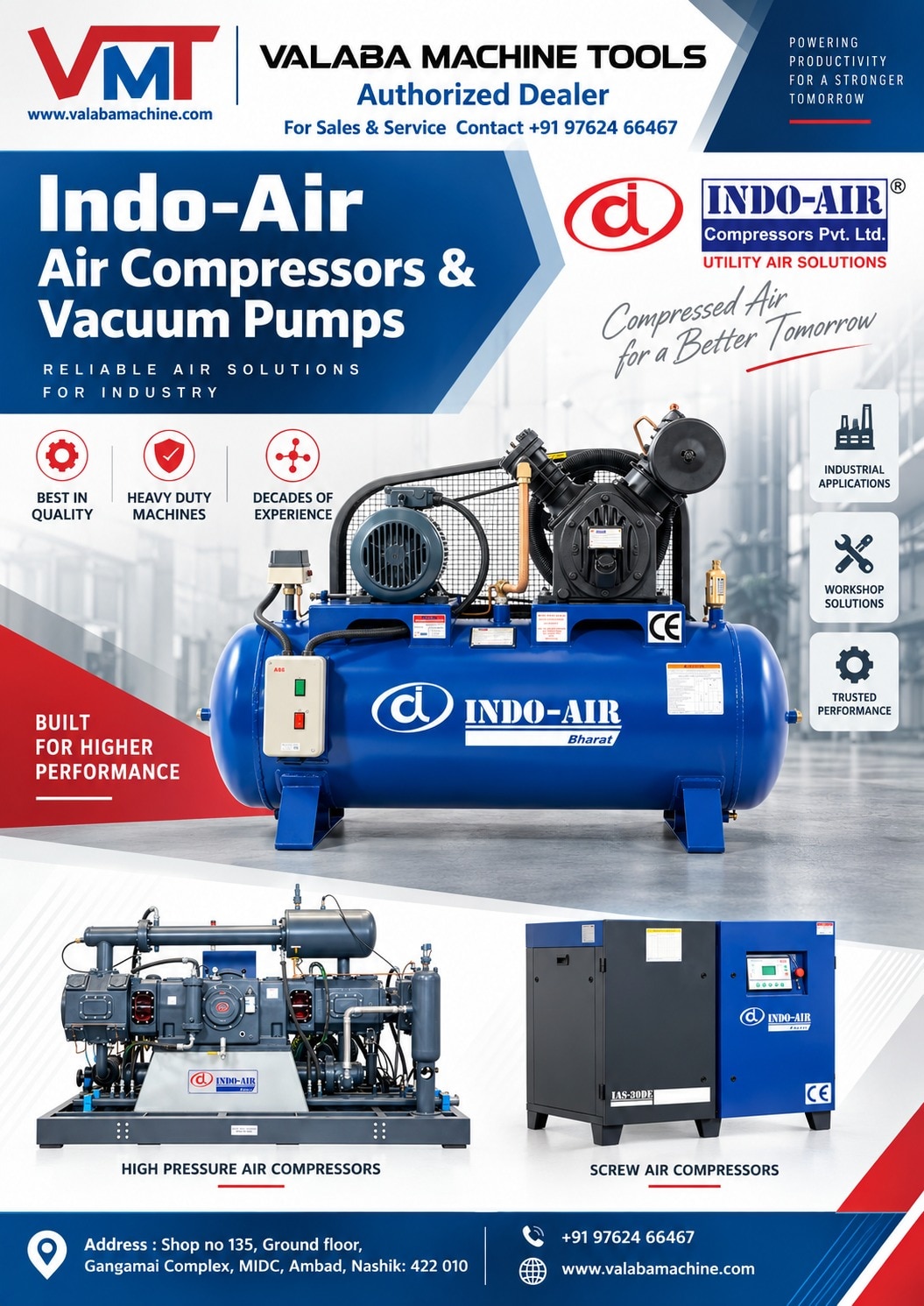 | Air Compressors Valaba Machine Tools offers reliable and efficient screw air compressors designed to provide a continuous supply of compressed air for industrial,... View product → |
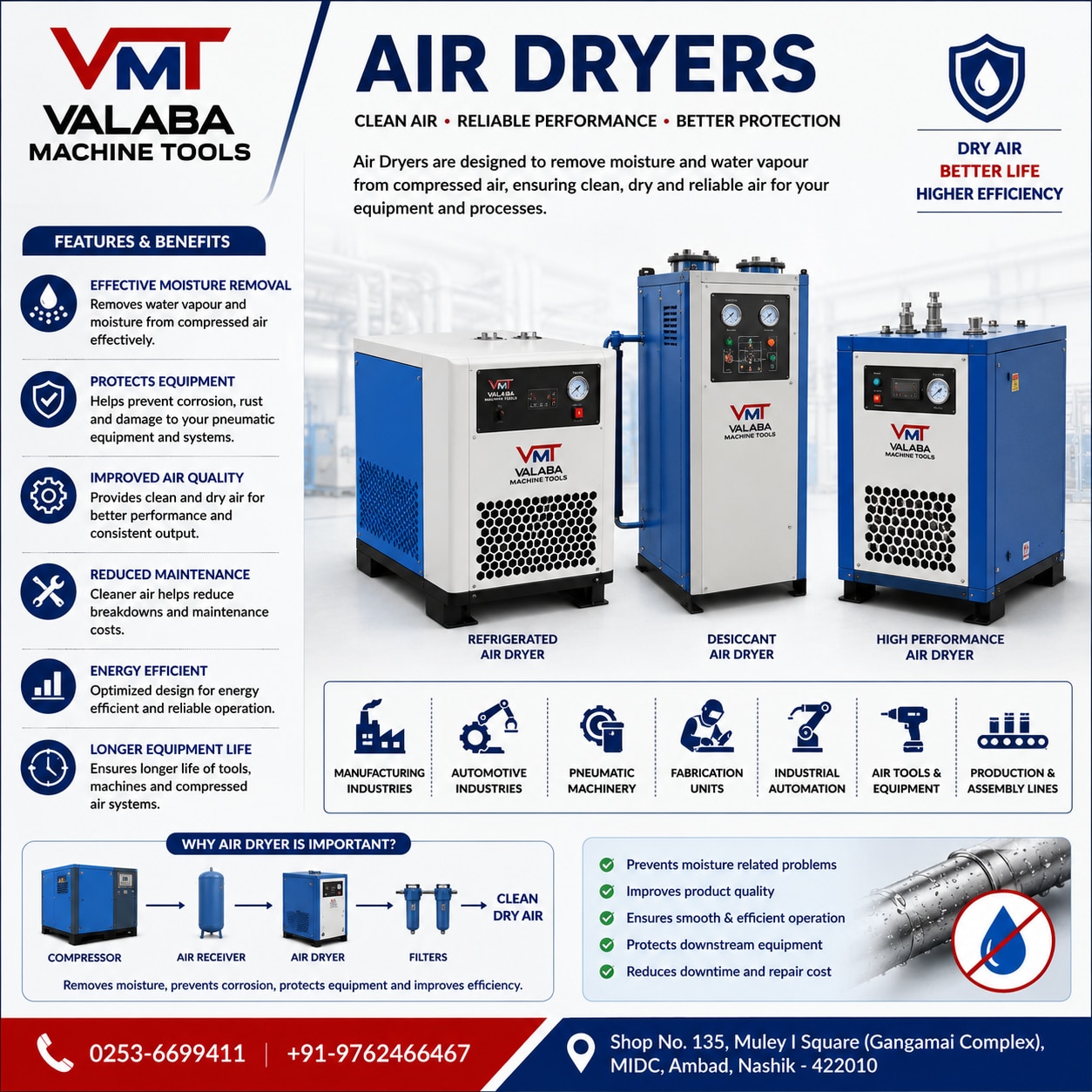 | Air Dryers are essential components of compressed air systems, designed to remove moisture and water vapour from compressed air before it reaches... View product → |
Frequently asked questions
How does compressed air drive pneumatic tools?
Pressurised air pushes a piston, rotates a vane motor, or moves an actuator; exhaust air then leaves the tool.
Why should you size a compressor by delivered air?
Delivered air shows how much usable air reaches the system, while horsepower alone does not account for compressor efficiency or pressure.
How do you keep pneumatic tool pressure stable?
Use correctly sized pipes, hoses, filters, regulators, and a receiver, then measure pressure at the tool during operation.
What else can industrial compressed air do?
It can actuate valves, power automation equipment, inflate components, blow debris, and support cleaning when used with safe practices.
How should compressor type match the duty cycle?
Choose controls and compressor capacity for the tool’s running time, air demand, starts and stops, and periods of peak consumption.
Related product
 | All Machine & Air Compressor Spares Valaba Machine Tools offers a comprehensive range of machine and air compressor spare parts designed to support the smooth, reliable, and efficient... View product → |