An under-crank shear cuts sheet and plate by driving an upper blade past a fixed lower blade, but its usable capacity depends on material strength, blade settings, support and machine geometry. By the end, you will be able to follow the cutting cycle, check the main setup variables, judge suitable applications and ask the right questions before operating or buying one.
Key takeaways
- The crankshaft sits below the cutting table and converts rotation into a shear-beam stroke.
- Set blade clearance to suit the sheet thickness and material strength.
- Align the back gauge, support the sheet, and test the first blank before production.
- Use under-crank shears for straight blanks, not complex profiles or very thick plate.
What “Under Crank” Means in the Machine’s Mechanism
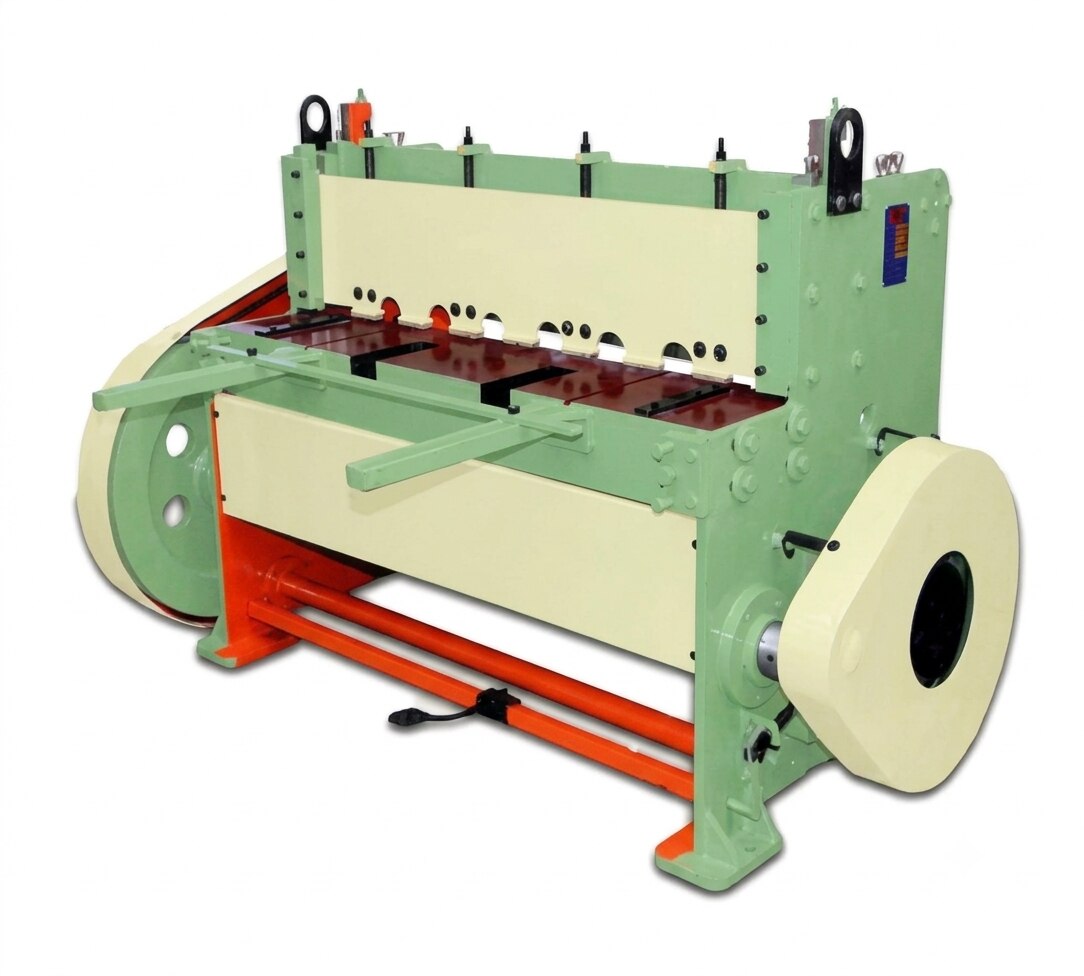
An under-crank shearing machine places its crankshaft below cutting table level, not above the moving shear beam. A motor spins a flywheel, which stores energy and releases it through a clutch into the crank or an eccentric mechanism for shearing machine drive. Rotation becomes a straight downward-and-upward stroke.
Identify the main parts this way:
- Crankshaft: the rotating shaft below the table that delivers drive.
- Eccentric: an offset crank feature that converts rotation into reciprocating motion.
- Links or connecting rods: members transferring crank movement to the beam.
- Shear beam: the moving upper member carrying the blade holder.
- Upper blade holder: the clamp that secures the descending blade.
- Lower blade: the stationary cutting edge fixed in the bed.
- Bed: the rigid table supporting the sheet and lower blade.
As the crank rotates, the links push the shear beam and upper blade downward, then pull them back to the starting position while the lower blade stays fixed.
This under-crank shear mechanism keeps the drive below the work area, producing a relatively low upper structure; it is a mechanical shear, not a hydraulic guillotine with a different name.
Stored flywheel energy enables rapid repeated strokes for production, but the fixed cycle makes clutch control, guarding, stopping and energy isolation critical around the blade line, linkage and flywheel.
How the Blades Separate the Sheet During Each Cut
A complete cut begins with the sheet flat on the bed, not with the crank moving. Align its edge against the side gauge or back gauge, support any overhanging material, and confirm that the hold-downs will clamp it before the blade reaches the cut.
1. Check alignment, blade-line clearance, hold-down action and sheet stability before every cut. Keep hands and loose material outside the blade and hold-down zones.
2. Start the crank or clutch. The upper blade begins its blade descent toward the fixed lower blade while the hold-downs press the sheet down, preventing lifting and sideways movement.
3. The rake angle makes only part of the blade length engage at one time. The upper and lower blades create a shearing action: the upper edge penetrates, plastically deforms and separates the sheet against the lower edge in a controlled shearing zone.
4. The beam completes the stroke, the cut-off separates, and the blade returns during the return stroke. Remove the blank only after the motion has stopped.
Insufficient clamping lets the sheet wander, producing a tapered dimension or surface marks; it can also eject the offcut. Excessive pressure can mark thin sheet. A zero-rake cut engages the blade length together, while a rake angle lowers peak force but can increase strip movement or twist.
If the result is poor, inspect clamping, alignment and blade clearance rather than assuming the blade alone is at fault.
How to Match Capacity, Material and Blade Clearance
A rating such as 6 mm × 2,500 mm is conditional, not a promise to cut every 6 mm metal across the full blade length. Verify the material grade and tensile-strength range behind the figure, then compare them with your job.
| Material | What to verify | Capacity implication |
|---|---|---|
| Mild steel | Grade and tensile range used for the rating | Usually the reference material |
| Stainless steel | Tensile strength and maker’s derating chart | Higher strength raises cutting force; obtain confirmation before cutting |
| Aluminium | Alloy, temper and specified thickness limit | Different limit; aluminium sheet cutting can produce burrs, distortion and surface marks |
| Other alloys | Tensile strength and capacity-chart entry | Do not estimate from thickness alone |
A complete shearing machine capacity check includes plate thickness, tensile strength, blade length, maximum cutting length, permissible load distribution, and the rated motor, flywheel and drive limits. A short, off-centre sheet can concentrate force on one blade area and load the beam unevenly, even when its thickness is below the headline rating.
Check the manufacturer’s minimum workpiece size and loading instructions.
Blade clearance for sheet metal is a production setting, not a maintenance guess. Too little clearance raises force and can chip the edges; too much causes rollover, a wide burr, distortion or incomplete separation. Set the clearance for the specific material and thickness using the machine manual’s value or adjustment procedure.
A burr may also indicate blunt blades, unequal gap or weak hold-down pressure, so replacing blades alone may not cure it.
How to Set Up the Machine for Repeatable, Safe Blanks
A repeatable blank starts with a blade and beam that are correctly aligned, not with the back gauge setup. Before rotating a reversible or four-edge blade, confirm the blade profile, sharp edge, mounting orientation, fasteners and specified clearance; these features are not standard on every under-crank shear.
Set the blade gap along the full cutting length, confirm the upper blade’s rake or blade angle, and verify that the shear beam and bed remain parallel. An uneven gap leaves a burr on one side, and replacing the blade will not fix poor alignment.
Position the back gauge for the blank length, then support long or flexible sheets separately. A gauge alone cannot prevent sagging or rotation.
| Support method | Purpose | Failure if omitted |
|---|---|---|
| Front supports | Carry the sheet before the cut | The leading edge drops |
| Extension table | Support wide or long stock | The sheet pivots at the bed |
| Roller supports | Control continuous feeding | The sheet drifts or twists |
Use a side gauge and square reference for the first trial cut. Measure the blank’s length, width and diagonals; correct alignment until the squareness of sheared blanks meets the drawing before repeating the batch.
Before each cut:
- Keep hands outside the blade and hold-down zone.
- Place the sheet flat, seat it against the gauge, and apply adequate hold-down pressure.
- Confirm that the offcut has a controlled landing area.
- Cycle only when nobody can reach the blade line, linkage, crank or flywheel.
Provide machine guarding for shears, unintended-cycle prevention and lockout isolation for adjustment. OSHA 29 CFR 1910.212 covers US guarding duties; PUWER is the UK framework. EN 13985 covers hydraulic guillotine shears, not proof of compliance for a mechanical under-crank machine.
Where an Under-Crank Shear Fits in a Fabrication Process
Use an under-crank shear for straight-line sheet metal cutting: blanking, trimming plate, squaring edges and preparing blanks for press-brake forming. Repeated mechanical cycles suit batches of identical cuts. It cannot make internal holes or curved contours; use punching, nibbling, laser, plasma or waterjet equipment for apertures and profiles.
Mechanical versus hydraulic shear selection comes down to cycle speed and control.
| Option | Working advantage | Limitation |
|---|---|---|
| Mechanical under-crank shear | Flywheel energy drives rapid repeated strokes | Stored energy and a fixed stroke make stopping, inching and guarding critical |
| Hydraulic shear | Fluid power can normally stop or hold the beam | Cycle speed and energy recovery may suit production less well |
Your shearing machine buying checklist should ask for:
- Rated thickness for each material and tensile-strength range
- Full blade length, minimum workpiece size and allowable short-workpiece loading
- Permissible cutting distribution across the blade
- Stroke rate, clutch type and stopping arrangement
- Hold-down design, front supports or roller tables
- Blade-clearance range and guarding provisions
A poor cut does not automatically mean blunt blades. Inspect burr location, clearance, blade sharpness, gap uniformity, clamping and material strength before replacing anything. For a Nashik job, Valaba Machine Tools can help compare these figures with available machines against the actual sheet-cutting pattern, not merely the headline capacity.
Related product
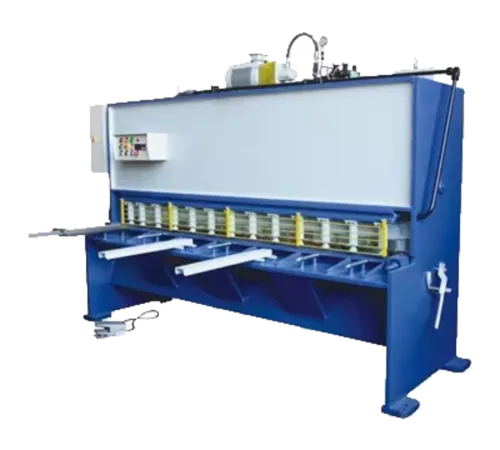
 | Steel Body Under Crank Shearing Machine. Frame : The Frame is fabricated from steel plates of is 226 Grade. View product → |
Frequently asked questions
What does “under crank” mean in a shearing machine?
It means the crankshaft or eccentric drive sits below cutting-table level. A motor drives a flywheel, clutch and crank mechanism to move the shear beam through its cutting stroke.
How do the blades separate the sheet during a cut?
The upper blade moves past the fixed lower blade with a controlled gap. The blades first bend and then fracture the sheet along the cut line.
How do you match blade clearance to the material?
Use the machine maker’s clearance chart for the sheet thickness and material. Soft, thin sheet needs a different gap from thick, high-strength steel; incorrect clearance causes burrs, distortion or excessive load.
How do you set up an under-crank shear for repeatable blanks?
Inspect the blades and guards, set the back gauge, square the sheet against the stops, support long stock, and make a test cut before repeating the dimension.
Where does an under-crank shear fit in fabrication?
It is suited to fast, straight cuts that produce blanks for bending, forming or welding. Choose a press brake, band saw, plasma cutter or laser when you need formed edges, curves, thick plate or intricate profiles.