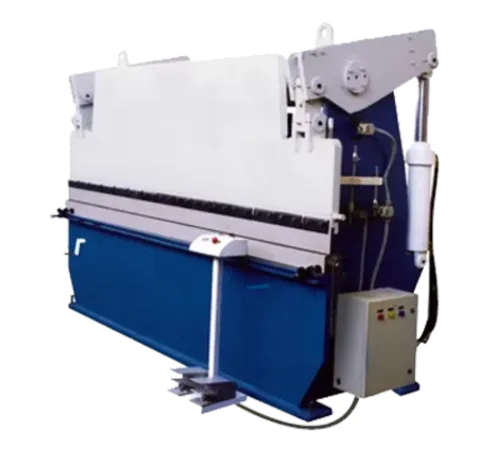
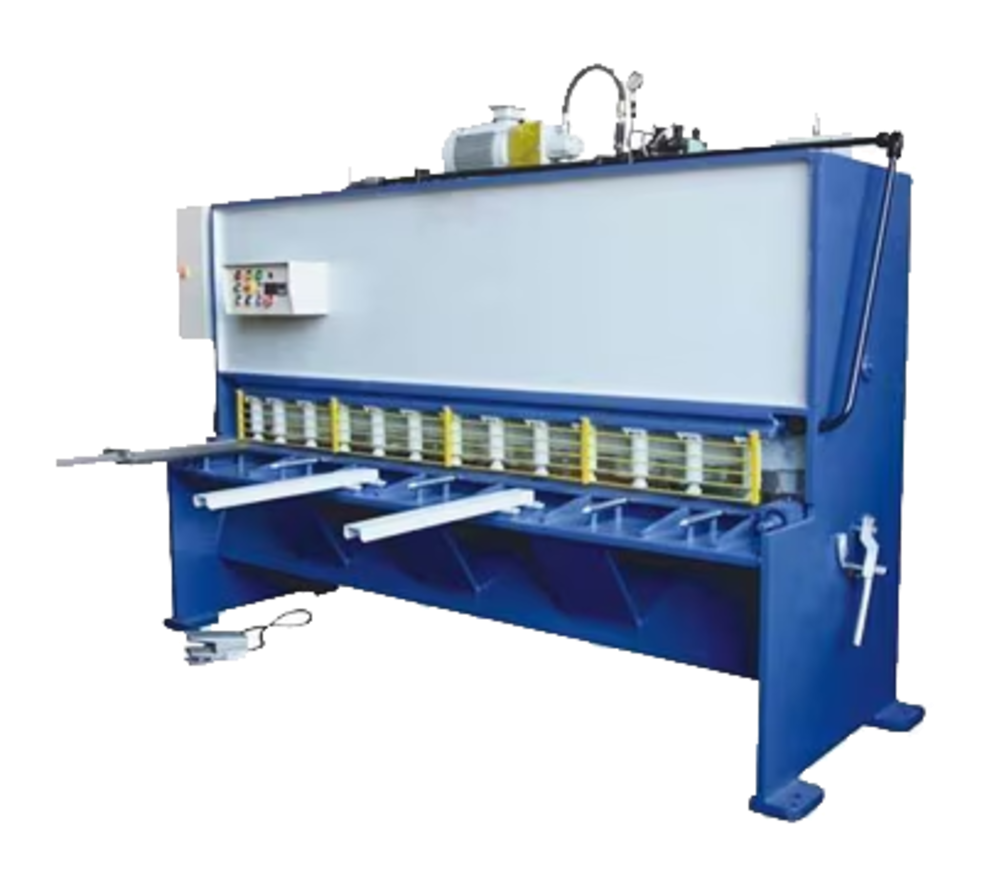
A clean shear cut depends on more than hydraulic power or a machine’s advertised maximum thickness. By matching capacity, blade clearance, hold-down performance, accuracy specifications and rigidity to your actual materials and cut sizes, you can compare machines and verify whether one will deliver consistent edges in production.
Key takeaways
- Match rated thickness and width to your actual material and cut sizes.
- Check blade clearance, rake angle and hold-down performance before comparing prices.
- Test cut accuracy and frame rigidity instead of trusting nominal capacity alone.
- Request safety documents, maintenance requirements and supplier support terms in writing.
How a hydraulic shear produces a straight, repeatable cut
A hydraulic shear produces a straight, repeatable cut by controlling the sheet as the blade enters, passes through, and leaves the material. Hydraulic cylinders lower the blade beam while hold-downs clamp the sheet against the bed. The blade then penetrates, fractures, and separates the strip before the beam retracts.
Cutting clearance—the gap between the upper and lower blades—must match the material: excessive clearance increases burr and rollover, while insufficient clearance raises force and can distort the edge.
- The back gauge positioning system places the sheet at the programmed length. Confirm its positioning accuracy and repeatability separately; backlash, a dirty stop face, springback, or a bowed thin sheet can still shift the cut.
- The hold-downs must contact the sheet evenly before cutting. Too little pressure allows lifting, angled cuts, local burrs, and waviness; too much pressure can mark thin or prefinished material.
- The blade beam and frame must remain rigid across the bed. Long beds need hydraulic or mechanical crowning to offset deflection and keep the blade gap consistent at the centre and ends.
| Feature | Correct control | Typical consequence when wrong |
|---|---|---|
| Blade clearance | Set for material and thickness | Burr, rollover, excess force, or distortion |
| Hold-downs | Even force, suitable spacing and feet | Sheet movement or surface marking |
| Crowning | Compensates for bed deflection | Different edge quality along the cut |
| Blade condition | Sharp, properly aligned edges | Rough fracture and inconsistent dimensions |
Match capacity, blade setup and material to the work
A machine’s maximum thickness is meaningful only against the material’s tensile strength, cutting length and supported width. Require the supplier to state the tensile-strength basis, whether the rating applies across the full bed, and the pressure the hydraulic system maintains during the cut; rated force alone does not prove capacity.
| Material | Capacity and force | Setup risk |
|---|---|---|
| mild steel | Use as the baseline for the quoted thickness rating | Excessive clearance leaves rollover and burr |
| stainless steel | Needs derating because higher strength raises cutting force | Wrong clearance accelerates wear and worsens the fracture edge |
| aluminium | Lower force, but the softer surface marks and distorts easily | Use sharp blades and controlled hold-down pressure |
| high-strength steel | Needs a substantial capacity margin and confirmed tensile rating | Insufficient rigidity or clearance produces heavy burr and blade damage |
Specify the complete working range, not just the thickest sheet. Ask for minimum and maximum thickness, maximum sheet width, maximum cut length, minimum supported width and minimum cut length; a short strip can concentrate force over too few hold-downs or blades and fall outside the rating.
Blade geometry controls how the fracture develops. A suitable rake angle reduces distortion, while sharp, correctly oriented blades limit rollover; four-sided blades reduce replacement cost only if each edge is ground and set accurately.
Set clearance for both thickness and material. Too little clearance raises force, edge loading and wear; too much creates burr, rollover and twist. Choose convenient adjustment if your work spans thin sheet through heavy plate, and test several positions along the bed for burr height, squareness and distortion.
Compare the shear with other cutting methods before you buy
Choose a hydraulic shear for repeated straight cuts across broad sheet, especially when variable thickness, long cut lengths and programmable back-gauge positions matter. It is not automatically cleaner than a mechanical machine: blade clearance, sharpness, hold-down pressure, rake angle and frame rigidity control the edge.
| Method | Best choice | Choose another method when |
|---|---|---|
| Hydraulic shear | Production straight cuts in sheet and plate, with adjustable force and long cutting lengths | You need holes, contours or detailed profiles |
| Under-crank shearing | Light-to-medium work, simple operation and lower purchase cost | You need high production speed, thick material or extensive automation |
| Mechanical guillotine shear | Fast repetitive cuts where a flywheel supplies consistent mechanical power | You need frequent thickness changes, variable force control or quieter operation |
| Laser cutting | Tight-tolerance profiles, holes, slots and nested parts with minimal secondary work | Reflective, very thick or highly heat-sensitive material exceeds the laser’s process window |
| Plasma cutting | Fast profiling of conductive plate, especially carbon steel and stainless steel | You need a narrow heat-affected zone or a finished edge without dross |
| Waterjet | Heat-free cutting of thick, reflective or laminated materials | Cutting speed, water management or operating cost rules it out |
| Band saw | Cutting bars, tubes, sections and small stock into blanks | You need a straight cut across wide sheet |
Compare the rated tensile strength, cutting length and full-bed capacity, not maximum thickness alone. On long beds, demand crowning or another deflection-compensation system; otherwise the center and ends can produce different burrs.
Specify accuracy and test rigidity instead of trusting a nominal rating
Specify back-gauge positioning accuracy and repeatability separately, with the measurement method and reference length stated. Also set a maximum cut-length tolerance, squareness tolerance, and edge burr height for the buyer’s actual materials, including thin sheet—not only the machine’s maximum rating.
| Item | Specification to request | Acceptance check |
|---|---|---|
| Back gauge | Positioning accuracy and repeatability in millimetres | Take repeated readings at short, medium and long settings |
| Cut length | Tolerance over the required cutting range | Measure parts from both ends and the centre of the bed |
| Squareness | Maximum diagonal or angular deviation | Compare a full-width cut with a calibrated square |
| Edge quality | Maximum edge burr height and allowed rollover | Inspect cuts in mild steel, stainless steel and aluminium |
| Bed rigidity | Deflection limit and stated crowning system | Compare blade-gap behaviour and cut results at both ends and centre |
Require the supplier to state the tensile strength behind the thickness rating and confirm that capacity applies across the full bed. Check the frame, blade beam, table and hold-downs for deflection under load; a long bed without hydraulic or mechanical crowning can produce different burr and fracture quality at the centre than at the ends.
- Record at each test position: cut-length tolerance, squareness tolerance, edge burr height, rollover, visible marking and sheet distortion.
- Reject a machine that passes at one position but fails at another, even if its nominal accuracy figure looks acceptable.
Review ownership, safety documentation and supplier support
Accept the machine only when ownership tasks, safety documents and commissioning responsibilities are written into the order.
1. Request the hydraulic maintenance schedule, approved oil specification, oil filtration rating, filter-change intervals, accessible pressure test points and permissible oil-temperature range. Confirm how technicians will detect seal leakage, valve drift, clogged filters and cooling problems; each can change cycle timing or pressure stability.
2. Check blade instructions before cutting production material. Confirm whether the machine uses four-sided blades, the permitted blade rotation sequence, blade hardness and edge angle, and who provides grinding or replacement. After blade rotation, the blade gap must be reset and recorded; incorrect installation can create burrs or a tapered edge.
3. Demand the guarding and conformity file for the exact machine configuration. It should identify the edition of EN 13985 and include the risk assessment under ISO 12100, control-system information against ISO 13849-1, and electrical documentation associated with IEC/EN 60204-1.
Inspect interlocked access points, emergency stops, foot-pedal protection and the line of sight to the cutting zone.
4. Put commissioning in writing: levelling, hydraulic checks, blade-gap setup, back-gauge calibration, hold-down verification, operator training and trial cuts across the bed. Record results on your material, including burr, cut angle and repeatability.
Ask Valaba Machine Tools who attends commissioning, what response time applies to breakdowns, which parts are stocked locally, and whether service staff supply written setup support rather than only a delivery note.
Related products
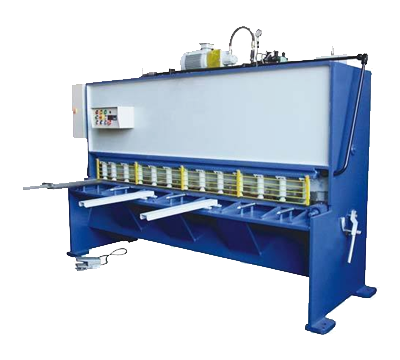 | SHEARING MACHINE Steel Body Hydraulic Shearing Machine. Frame : The Frame is rigidly constructed from Solid steel plates with safeguards, It’s interlocked design... View product → |
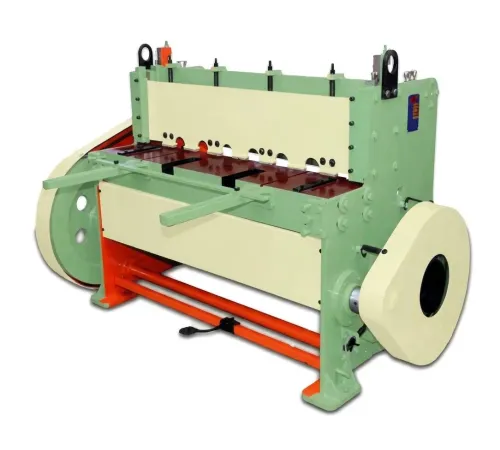
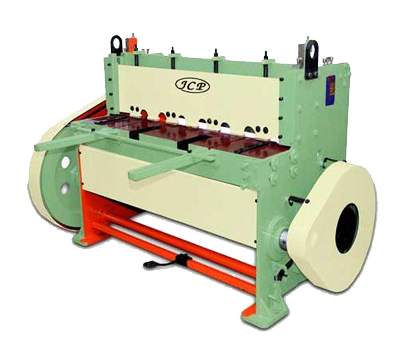 | Steel Body Under Crank Shearing Machine. Frame : The Frame is fabricated from steel plates of is 226 Grade. View product → |
Frequently asked questions
How does a hydraulic shear produce a straight, repeatable cut?
Hydraulic cylinders lower the blade beam while hold-downs clamp the sheet against the bed. Controlled blade penetration and retraction produce consistent cuts.
How should you match a hydraulic shear to your work?
Compare the machine’s rated thickness and cutting width with your material grade, sheet size, blade setup and expected production volume.
How does a hydraulic shear compare with other cutting methods?
A shear suits fast, straight cuts, while lasers, plasma, waterjet and abrasive saws offer different advantages for profiles, thick stock, heat-sensitive materials or lower-volume work.
What should you test before buying a hydraulic shear?
Inspect frame rigidity, cut a representative sheet, measure repeatability and verify blade clearance, rake angle, squareness and edge quality.
What ownership and safety information should you request?
Ask for guarding details, emergency-stop arrangements, operating instructions, maintenance intervals, hydraulic-service requirements, spare-blade information and supplier support terms.