
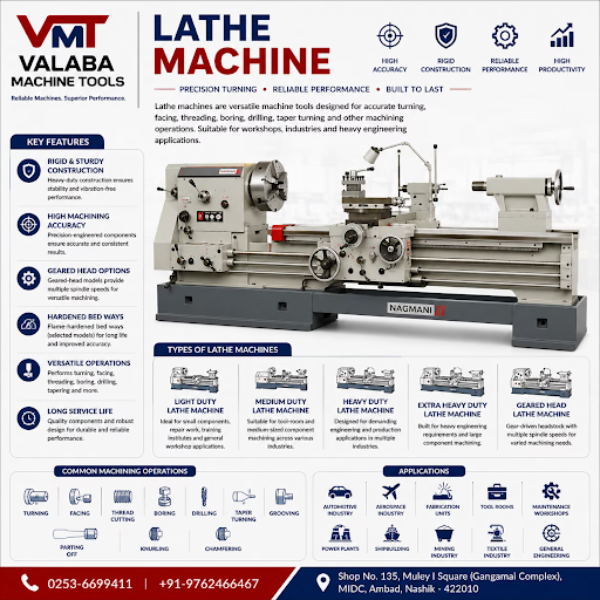
A lathe is one of the most widely used machines in engineering workshops because it supports a broad range of turning, facing, threading, boring, knurling, and component-finishing operations. However, selecting a machine should involve more than comparing specifications on a quotation. Working with the right lathe machine dealer can help a manufacturing business choose equipment that matches its actual production requirements.
For machine shops and engineering companies in Nashik, Maharashtra, the correct lathe configuration depends on the components being produced, material characteristics, required accuracy, production frequency, operator skills, and available floor space.
Start With the Components You Need to Machine
A common purchasing mistake is selecting a lathe based mainly on price or overall machine size. The better starting point is the workpiece.
Before evaluating machines, consider:
- Maximum component diameter
- Maximum machining length
- Materials commonly processed
- Required spindle speeds
- Typical machining operations
- Expected production volume
- Accuracy and surface-finish requirements
- Chuck and tooling requirements
A workshop machining small precision components has different requirements from a fabrication unit handling long shafts and larger industrial parts.
Understanding these differences helps narrow the available machine configurations.
Check the Important Machine Specifications
Once the application is clear, technical specifications become easier to evaluate.
Swing over bed indicates the maximum diameter that can rotate over the lathe bed. Distance between centres affects the length of components that can be accommodated. Spindle bore is particularly important when bars or long workpieces need to pass through the spindle.
Other specifications worth reviewing include spindle speed range, motor power, bed construction, feed range, threading capability, tailstock arrangement, and available accessories.
Instead of looking at one specification in isolation, evaluate how the complete machine configuration fits the intended work.
Consider Accuracy Along With Capacity
A larger machine is not automatically a better machine.
For many automotive component manufacturers, maintenance workshops, tool rooms, and general engineering units, repeatability and machining stability may be more important than maximum capacity.
Bed rigidity, spindle condition, alignment, slide movement, tooling setup, and operator practices can all influence the finished component.
A dependable lathe machine dealer should therefore discuss the intended machining application rather than recommending equipment solely according to nominal size.
Think About Daily Workshop Conditions
Machines operate as part of a production environment. Available electrical supply, foundation requirements, operator access, material movement, coolant handling, chip removal, and maintenance space should all be considered before installation.
This is particularly relevant in established industrial units where a new machine must be integrated into an existing layout.
Manufacturing facilities across Nashik's industrial areas may also need to consider how quickly components move between cutting, turning, drilling, inspection, and assembly operations.
Plan for Tooling and Future Work
The machine itself is only part of the investment.
Chucks, tool posts, centres, cutting tools, coolant arrangements, measuring instruments, and other accessories influence how effectively the lathe can be used.
It is also sensible to consider likely future requirements. Buying excessive capacity creates unnecessary investment, but choosing a machine with almost no flexibility can become restrictive when component sizes or order profiles change.
Valaba Machine Tools can be considered when businesses are evaluating machine-tool requirements for production, maintenance, and engineering applications in Nashik.
The most suitable lathe is ultimately the one that matches the work being performed consistently. By defining component dimensions, operations, accuracy expectations, production volume, and workshop conditions before purchasing, manufacturers can make a more practical equipment decision.