A horizontal bandsaw keeps the workpiece fixed in a vice while a continuously rotating blade descends through the stock, but the result depends on far more than motor power. By matching blade pitch, speed, feed, capacity, workholding and control method to the section being cut, you can produce straighter, cleaner and more repeatable cuts across solid bar, tube, structural sections and bundles.
Key takeaways
- Use coarse blade pitch for thick sections and fine pitch for thin-wall stock.
- Reduce blade speed for hard alloys and increase it for softer metals.
- Check capacity for bundled, round and angled stock—not only square-cut width.
- Choose automation based on batch size, loading time and required cut consistency.
How the blade, vice and coolant work together during a cut
A horizontal bandsaw handles fixed, repeatable straight cuts because the vice holds the workpiece while the saw head feeds through it.
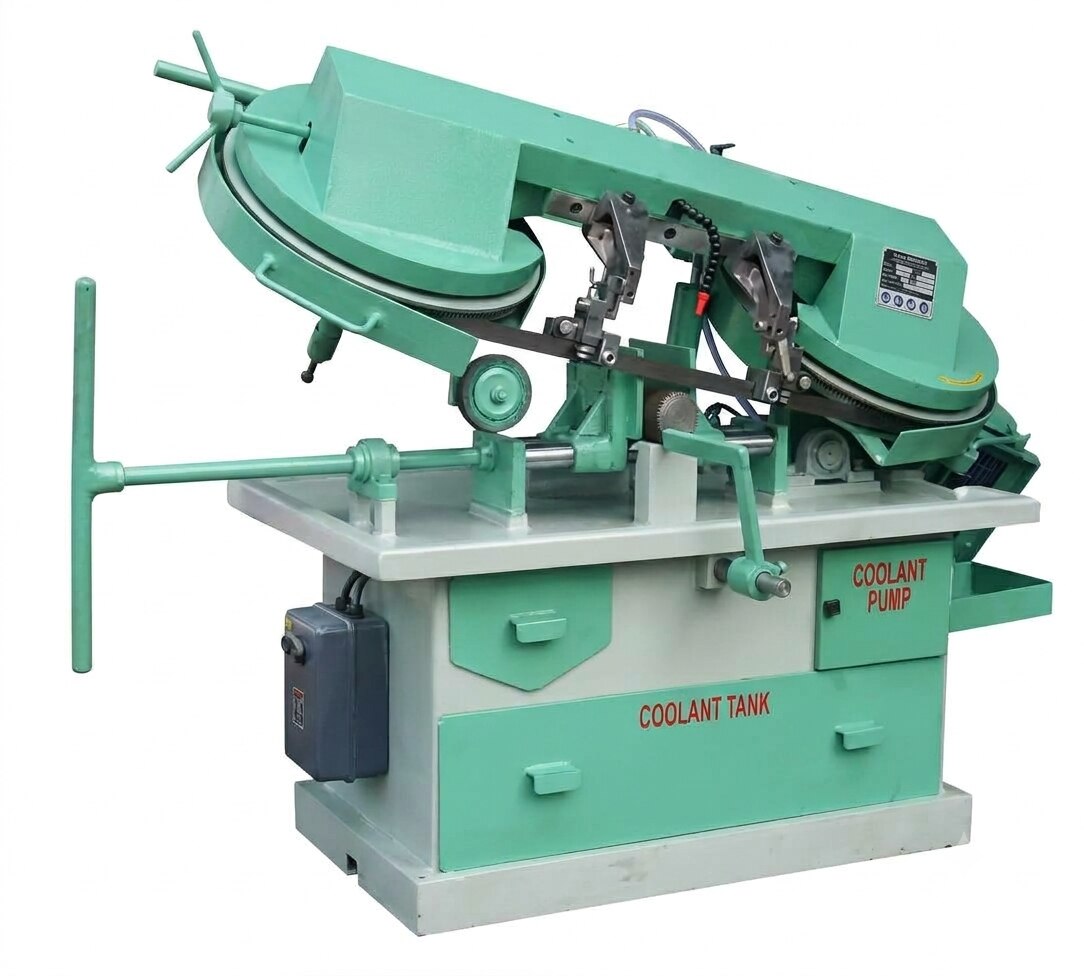
In the horizontal bandsaw cutting process, stock rests on the machine bed against the vice jaws; blade rotation carries the continuous blade around the drive and idler wheels as the saw head descent drives it horizontally through the cut.
- Set the stock firmly against both vice jaws and support long sections on level rollers or the bed. Close the vice so the work cannot lift, rotate or slide; a blade can pass through and still leave a tapered or out-of-square cut when workholding is poor.
- Check that the blade guides sit close to the material and keep the blade aligned. Correct guide clearance and tension prevent wandering, while the vice clamping and workholding preserve the cut line.
- Aim coolant at the teeth as they enter the kerf. It reduces heat and carries chips away, but a misdirected stream can push chips into the guides; a worn brush leaves chips recirculating around the blade. Keep the brush contacting the blade and empty the chip tray before it blocks removal.
This setup suits solid round and square bar, rectangular stock, pipe, tube, angle and restrained bundles. It suits production cut-off work, not freehand shapes: use a vertical bandsaw for contour cutting, where you guide the work across a table.
How to match blade pitch, speed and feed to the material
Several teeth must stay engaged in the cut, so choose bandsaw blade pitch from material thickness and cross-section—not outside diameter alone. A coarse tooth can catch thin-wall tube or strip and strip teeth; excessive tooth count causes rubbing, friction and poor chip evacuation.
- Use coarse pitch for large solid bar.
- Use finer pitch for small sections and thin walls.
- Choose a variable-pitch blade for tube, channel and structural sections; its changing tooth spacing reduces repeated impact and vibration.
- Use a bi-metal blade for general-purpose carbon steel, alloy steel, stainless steel and many nonferrous alloys.
2. Set blade speed and feed pressure separately. Blade speed follows the material and blade type; feed pressure controls chip thickness. Reducing speed will not cure rubbing caused by weak feed, while excessive feed can overload teeth or stall the drive.
| Material | Setup priority |
|---|---|
| Mild steel | Moderate speed with steady feed pressure |
| Stainless steel | Lower speed and positive feed; dwelling work-hardens the surface |
| Aluminium | Higher speed with adequate chip clearance |
| Brass | Controlled speed and firm, even feed to prevent tooth grabbing |
| Harder or nickel-based alloys | Lower speed, positive pressure and rigid support |
3. Use carbide-tipped blades for hardened, abrasive or difficult alloys only when the machine has rigid columns, accurate tracking and low vibration. They are not a universal upgrade.
4. Break in every new blade at the intended speed with reduced feed pressure. After the blade maker’s stated initial length of cut, increase pressure gradually; skipping this step can chip teeth prematurely.
How capacity changes with stock shape, orientation and angle
A 300 mm round rating does not mean the machine accepts every 300 mm workpiece. Bandsaw cutting capacity depends on shape, orientation and the space available for the blade, jaws and saw head.
Compare the manufacturer’s maximum round, square and rectangular capacity at 90 degrees, then check the separate figures for other stock:
| Stock | Capacity figure to check | Main limitation |
|---|---|---|
| Round bar | Maximum diameter | Blade clearance and jaw opening |
| Square or rectangular bar | Width × height at 90 degrees | Rotation, support height and head stroke |
| Pipe or tube | Outside dimensions and wall section | Thin walls can deform under clamping |
| Angle or channel | Leg or flange dimensions | Jaw access and twisting |
| Bundled stock | Maximum bundle width and height | Restraint against movement between pieces |
A rectangular section can fit in one orientation and exceed the usable envelope after rotation. Jaw travel, support height, blade clearance and head stroke all reduce the practical limit.
Bundle cutting needs dedicated bundle clamps or top clamps where possible; simply closing the main vice around loose pieces allows individual sections to shift, rotate or lift, causing crooked cuts and tooth impact.
A swiveling vice for angled cuts or a rotating head increases flexibility, but capacity falls away from 90 degrees as effective cutting width grows. Before assigning miter work, verify:
- Swivel range and scale accuracy
- Repeatability at the required angle
- Throat, jaw travel and blade clearance
- Clamping access and support height
Double-column construction separates the columns and stiffens guide support, reducing head movement and vibration. That helps preserve squareness on larger or heavier stock.
What manual, semi-automatic and fully automatic control changes
The control system changes how the same blade-and-vice principle fits your workload. A manual bandsaw machine requires you to load and align every workpiece, close the vice, set the blade, and control head travel or shutoff.
| Control type | Operator involvement | Cycle and batch effect | Main control risk |
|---|---|---|---|
| Manual bandsaw machine | Loads, aligns and clamps each piece; controls descent and shutoff | Fast changeover for varied one-off work; limited batch output | Inconsistent alignment or clamping between pieces |
| Semi-automatic bandsaw | Loads stock and starts or supervises each cycle | Automates vice clamping, head descent, blade stop and return; suits small to medium batches | Incorrect setup remains possible at every loading |
| Fully automatic cutting cycle | Loads stock or replenishes the system; monitors operation | Adds programmed length, indexing, vice action, head feed, blade shutdown and return for repeated pieces | A setup error can repeat across the entire batch |
A semi-automatic bandsaw reduces handling time without removing the operator from the process. Fully automatic control earns its cost when repeated lengths and larger batches outweigh longer changeover and setup time; it does not make a cut more accurate simply because it uses more automation.
Hydraulic head feed or servo-controlled feed is valuable when you change between solid bar, tube and structural sections. It maintains feed force more consistently than a simple gravity head, but you still need the correct blade pitch, speed, tooth direction, alignment and workholding.
Automation cannot rescue a poor setup. An incorrect pitch, loose bundle, poor alignment or unsuitable speed will still cause vibration, tooth damage or an inconsistent cut.
Which specifications reveal whether the machine fits your cutting list
A machine fits your cutting list only when its published figures match your alloys, section sizes, angles and production rate. Use this bandsaw machine specification checklist before comparing prices:
- Ask for minimum and maximum blade speed, blade dimensions, available pitch range and feed-force control.
- Request 90-degree and miter capacity tables, maximum bundle size, swivel range, blade-guide adjustment and cutting rates for your exact alloy and section.
- Check blade tension, wheel tracking, guide-arm alignment, blade-guide condition, vice alignment, support rollers and feed stability; any failure can spoil cut squareness.
- Inspect coolant pump delivery, nozzle position, concentration control, filtration, chip removal and chip-conveyor availability. Poor coolant filtration and chip management can recirculate chips through the guides, cause foaming or corrosion, and create slippery floors.
| Specification | What to compare | Why it matters |
|---|---|---|
| 90-degree capacity | Round, square, rectangular, pipe and tube figures | Headline round capacity may not cover real stock |
| Miter capacity | Rated size at each angle, swivel range and scale repeatability | Effective cutting width increases away from 90 degrees |
| Bundle capacity | Maximum bundle dimensions and dedicated clamps | Loose sections can lift, rotate or shift |
| Feed control | Hydraulic or servo force and feed stability | Consistent chip thickness matters more than motor horsepower |
For machine selection for metal cutting, ask Valaba Machine Tools for application-specific capacity tables rather than relying on a catalogue headline. Test representative stock before purchase or a major changeover; the trial should confirm cutting rate, coolant behaviour and squareness.
Related products
 | BAND SAW MACHINE Catering to the varying market demands, we are engaged in Supplying and exporting Horizontal Metal Cutting Bandsaw Machine. View product → |
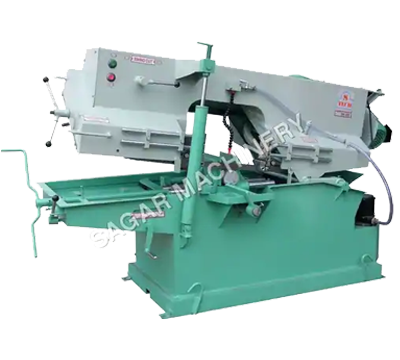 | BAND SAW MACHINE Engaged in offering quality-assured Metal Cutting Bandsaw Machine, we are a well-known supplier and exporter in this domain. View product → |
Frequently asked questions
How do the blade, vice and coolant work together during a cut?
The vice prevents movement, the blade removes material, and coolant carries heat and chips away from the cut. Set secure clamping and steady coolant flow before increasing feed.
How do you match blade pitch, speed and feed to the material?
Use blade pitch according to section thickness, lower speed for harder materials, and adjust feed until the blade cuts continuously without vibration, tooth stripping or excessive heat.
Why does bandsaw capacity change with stock shape, orientation and angle?
Capacity depends on the dimension presented to the blade. Round, rectangular, bundled and angled pieces engage different numbers of teeth and may require lower feed or tighter limits.
What specifications show whether a bandsaw fits a cutting list?
Compare maximum round and rectangular capacity, blade dimensions, speed range, feed control, vice opening, mitre range, motor rating and automation features with your stock and batch requirements.
Related products
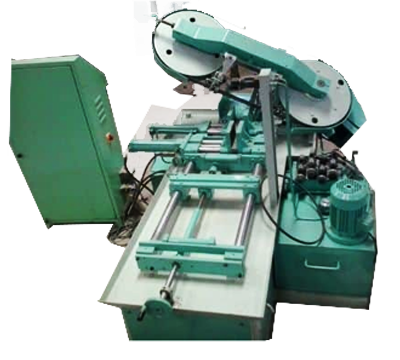 | BAND SAW MACHINE We are catering the increasing demands of our esteemed clients by offering an excellent array of Fully Automatic Metal Cutting Bandsaw Machine. View product → |
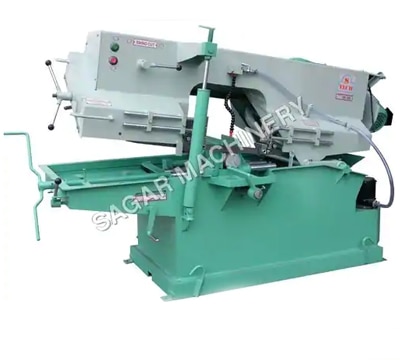 | BAND SAW MACHINE Engaged in offering quality-assured Metal Cutting Bandsaw Machine, we are a well-known supplier and exporter in this domain. View product → |
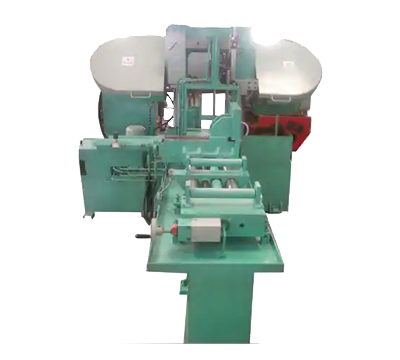 | BAND SAW MACHINE With core competency in this domain, we are instrumental in exporting and supplying a superior assortment of Fully Automatic Double Column Band Saw... View product → |
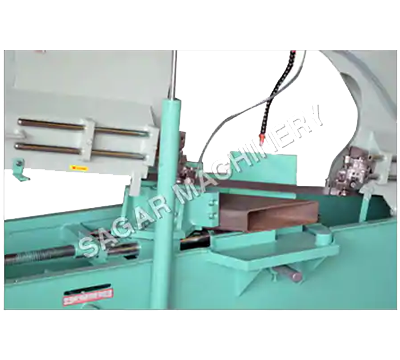 | BAND SAW MACHINE 12” BANDSAW WITH SWIVELING VICE With core competency in this domain, we are instrumental in exporting and supplying a superior assortment of 12” Bandsaw with Swiveling vice... View product → |