
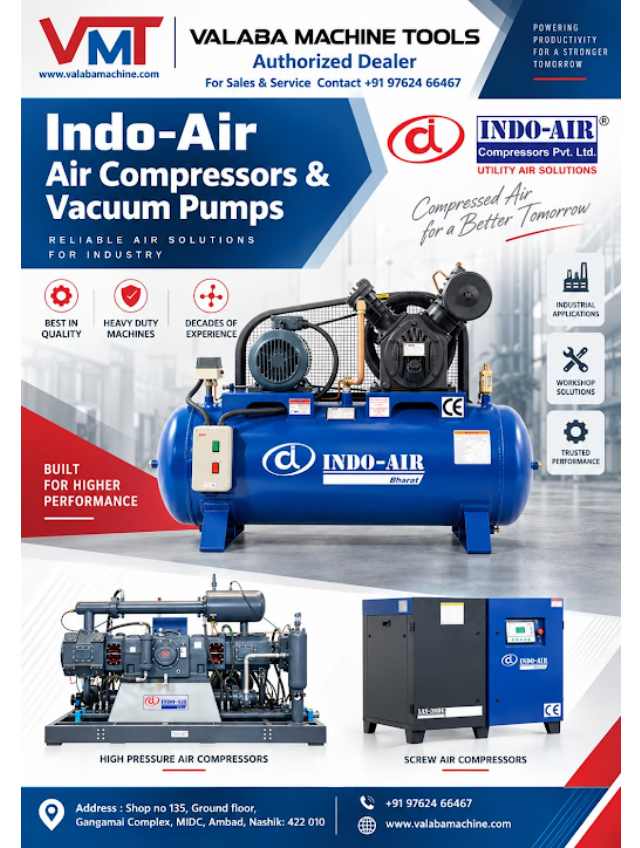
Compressed air can become an essential utility in a manufacturing facility, powering tools, pneumatic equipment, production machinery, cleaning systems, and automation. Because requirements vary significantly between factories, selecting an air compressor dealer should involve a detailed assessment rather than choosing equipment based on motor power alone.
Industrial buyers in Nashik, Maharashtra, can make better comparisons by evaluating air demand, pressure, duty cycle, energy use, air quality, installation conditions, and maintenance requirements together.
Calculate the Air Demand First
The compressor needs to supply enough air for equipment operating throughout the facility.
Start by listing pneumatic consumers and identifying their approximate airflow requirements. Consider which machines operate simultaneously rather than simply adding every theoretical maximum.
It is also sensible to account for reasonable future expansion.
An oversized compressor can create unnecessary capital and operating costs, while insufficient capacity may cause pressure problems when production demand increases.
Compare Pressure Requirements Carefully
Pressure and airflow are different specifications.
A compressor needs to provide adequate pressure at the point of use after accounting for pressure losses through dryers, filters, piping, fittings, and other system components.
Operating at unnecessarily high pressure may also increase energy consumption.
Instead of selecting a higher-pressure unit as a precaution, identify the actual pressure required by production equipment.
Understand the Duty Cycle
A workshop using compressed air intermittently has a different requirement from a production facility with continuous demand.
Duty cycle should therefore influence compressor technology and capacity.
When comparing proposals from an air compressor dealer, provide realistic information about daily operating hours, peak demand, shift patterns, and expected load variations.
This helps create a more meaningful comparison than simply matching compressor horsepower.
Look at Total Operating Cost
Purchase price is visible immediately, but electricity can represent a significant part of compressor operating expenditure over its service life.
Consider:
- Motor efficiency
- Loading characteristics
- Pressure setting
- Air leakage
- Maintenance requirements
- Filter condition
- Dryer-related pressure drop
- Control strategy
A lower initial equipment cost does not necessarily mean a lower long-term compressed-air cost.
Compare Air Treatment Requirements
The compressor is only one part of the system.
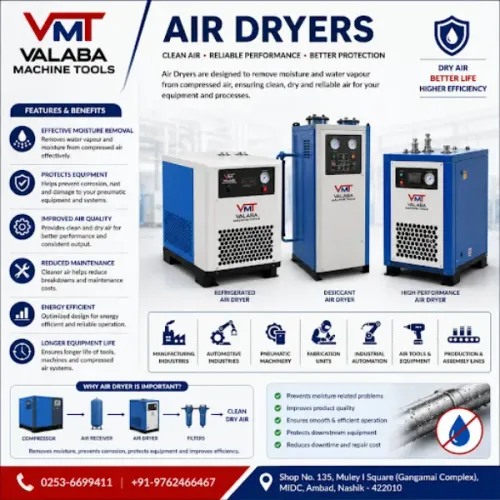
Depending on the application, the installation may also require an air receiver, moisture separator, dryer, filtration, drains, and correctly designed piping.
The required air quality should be determined by how compressed air is used.
Moisture or contaminants that may be tolerable for some workshop tools can be unacceptable for instrumentation, painting, and certain production processes.
Review Installation Conditions
Before finalising equipment, assess ventilation, ambient temperature, electrical availability, foundation requirements, maintenance clearance, noise considerations, and piping layout.
A well-selected compressor can still perform poorly when installed in unsuitable conditions.
For factories in Nashik's engineering and manufacturing clusters, installation planning is particularly important when new compressor equipment needs to integrate with an established production line.
Valaba Machine Tools can assist industrial buyers assessing compressed-air equipment alongside broader machine-tool requirements.
The strongest compressor proposal is not necessarily the one offering the largest machine. It is the one that demonstrates a clear relationship between plant air demand, operating pressure, duty cycle, treatment requirements, energy consumption, installation conditions, and maintainability. Comparing these factors systematically gives procurement and maintenance teams a much stronger basis for investment.