A bandsaw’s advertised capacity does not tell you whether it will cut your smallest tube, largest bundle, hardest steel or required mitre accurately. By checking the stock envelope, blade system, workholding, automation, installation requirements and after-sales support, you can compare machines against the jobs your workshop actually runs.
Key takeaways
- Size the saw for your hardest material and largest real workpiece.
- Check blade speed, pitch, tension and feed control together.
- Inspect vice alignment, blade guides and material support before buying.
- Match automation to workload, then prove the machine with your own parts.
Match the saw to your material and real cutting envelope
Start with the hardest material and largest part in your job mix, not the saw’s headline capacity. Confirm that the proposed machine safely handles:
- Carbon steel and alloy steel solids, where excessive speed overheats teeth and slow cutting increases rubbing.
- Stainless steel, where stable feed and chip removal matter because work-hardening can damage a blade.
- Aluminium, brass and bronze, where a steel cutting speed can strip teeth rapidly.
- Pipe, angle, channel and other structural sections, where interrupted cuts change tooth loading.
- Tool steel or hardened sections, if these occur in your workload; a general-purpose saw may not have the required rigidity or blade range.
Request capacities separately for round solid, square or rectangular stock, pipe, bundles and mitre cuts. A rating for a 90-degree round bar is not a universal envelope: a rectangular section’s height, a bundle’s outside dimensions and an angled cut can reduce usable capacity.
Check the smallest job as carefully as the largest. Ask for the manufacturer’s minimum cut length, minimum remnant length and a drawing showing the vice, fixed jaw, blade guides and blade positions. A saw that cuts a 300 mm bar may not safely retain a 25 mm remnant.
For production, verify the actual blade-speed range in metres per minute, cycle time on your parts, chip-brush contact, chip-tray access and safe removal of stringy stainless or aluminium swarf.
Compare blade speed, pitch, tension and cutting control
A machine that only lists motor horsepower tells you little about cutting control. Compare the feed system, blade drive and setup range against the rates your materials require.
| Feature | Compare | What failure reveals |
|---|---|---|
| Blade speed | Actual metres per minute range, not merely an inverter | Steel speed used on aluminium strips teeth; excessive slowness causes rubbing |
| Feed control | Adjustable hydraulic downfeed or controlled blade force, with rate and force settings | Uncontrolled descent can overload teeth when the blade enters a void or exits the cut |
| Blade size | Usable blade width and blade length range | A machine that accepts only one narrow blade limits stiffness, capacity and compatibility |
| Tooth selection | Available tooth pitch range and variable-pitch teeth | Coarse teeth strip on thin wall; fine teeth rub and load on thick solid stock |
| Tension | Tension indicator or documented setting for each blade width | Too little tension makes the blade wander; too much damages the blade, guides or wheels |
Ask which blade length and blade width the tension specification covers. A spring-loaded handwheel without an indication leaves a critical setting to guesswork.
Check the supplier’s pitch recommendation for the thinnest wall, thickest solid section and bundled stock you will cut. Each tooth must engage enough material to cut without stripping, but not so little that it rubs.
Prefer hydraulic feed over gravity feed when you need repeatable rates. Gravity feed can suit intermittent work, but require a controlled stop or descent limit before buying. Then demand a trial cut using your stock, chosen blade and intended speed; measure squareness and repeatability rather than accepting a catalogue tolerance.
Examine the vice, guides and support for accurate cuts
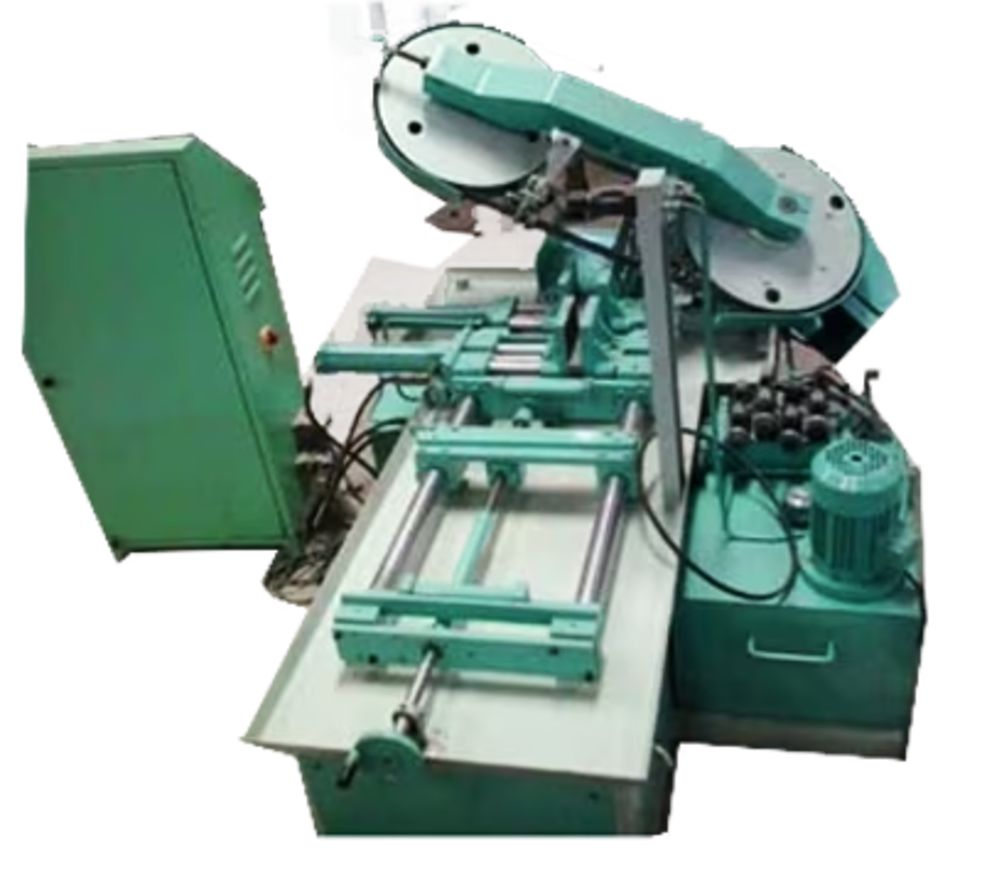
A vice that lets stock shift under feed pressure will turn a sound blade into a pile of tapered, non-square parts. Measure the vice opening against your actual stock, then inspect whether the fixed and moving jaws remain parallel as the opening changes.
Heavy vice construction matters: thin jaws can flex, while serrated or replaceable jaw faces improve grip on oily or uneven material.
Bring a sample bar and test the complete setup. Check the cut face with a machinist’s square and repeat the cut after releasing and reclamping the part; record the deviation rather than accepting a catalogue tolerance.
Ask for separate results at 90° and across the machine’s swivel range, because mitre-cut capability often reduces usable capacity and changes blade loading.
Blade guides must move close to the work and support the blade on both sides. A wide gap increases deflection on small sections; contaminated or misadjusted guide bearings and inserts cause angled cuts and premature blade failure. Confirm that these parts are replaceable and stocked as spares.
Long bars need level infeed and outfeed support aligned with the vice. Without it, overhanging stock can lift, twist or drag during the cut. Ask for the minimum workpiece and remnant lengths, plus a drawing showing the jaw, guide and blade positions; a machine rated for large rounds may not safely retain short parts.
Choose the operating design and automation level by workload
A horizontal bandsaw suits bar, tube and structural sections loaded from one side, while a vertical bandsaw suits irregular profiles, contour cutting and parts that need hand positioning. Choose a high-speed bandsaw only when its actual blade-speed range matches your materials; speed alone does not make it suitable for unattended production.
Manual operation is economical for intermittent work, but it transfers loading, feed control and cycle timing to the operator.
| Machine format | Best fit | Automation and workload implication |
|---|---|---|
| Horizontal bandsaw | Repetitive straight cuts from bar, tube or sections | Add hydraulic downfeed, automatic stop, length measurement or multiple indexing for batch work |
| Vertical bandsaw | Contours, notches, short pieces and irregular shapes | Usually depends on manual operation; unattended cutting is limited |
| High-speed bandsaw | Aluminium, brass and bronze when the blade system supports the required metres-per-minute range | Confirm speed control and tooth suitability; excessive speed can strip teeth on the wrong blade |
Do not size the machine by maximum capacity alone. Ask for the minimum workpiece length, minimum remnant length and a drawing showing the vice, fixed jaw and blade positions; a large-capacity saw can still reject short parts that cannot be retained safely.
Request cycle-time data for loading, indexing, cutting and chip removal, not just theoretical blade speed. For automatic feeding or bundle clamping, verify local support for sensors, hydraulics and wear items.
Before ordering, confirm the supply voltage, phase, full-load current, control-circuit voltage, motor protection, phase-sequence sensitivity and transformer or isolator requirement. For EU procurement, obtain the Declaration of Conformity, risk-assessment information, guarding and interlock details, and the applicable EN 13898 configuration for every powered option.
Prove the machine before purchase and plan installation support
Do not place the order until the supplier proves the saw on your material and confirms that your workshop can run it. Put every acceptance condition in the quotation, including commissioning, operator training, warranty coverage and who pays if the machine fails the test.
Valaba Machine Tools can use this document to align the quoted machine, site requirements and acceptance results.
1. Confirm the electrical installation: supply voltage, single- or three-phase requirement, full-load current, motor protection, control-circuit voltage, phase-sequence sensitivity, isolator size and whether a transformer is needed. Check floor loading, access width, lifting points, coolant drainage, infeed and outfeed space before delivery.
2. For EU procurement, require the Declaration of Conformity, risk-assessment information, guarding and interlock details, and the standard used. Check that the supplied configuration complies with EN 13898, including automatic feeding or powered bundling equipment. A CE mark alone is not enough.
3. Demand a witnessed trial cut using your actual stock, blade, bundle size and mitre angle. Measure squareness and repeatability, then record blade tension, guide alignment, feed force and support setup. Confirm that the vice clamps each bar or tube without movement and that long stock stays level.
4. Make serviceability contractual. Obtain electrical schematics, fault codes, lubrication and coolant intervals, recommended blades, guide-insert and brush part numbers, warranty terms, commissioning support and written lead times for wear parts, sensors and hydraulic components. A cheap machine becomes expensive when a proprietary guide stops production.
Related products
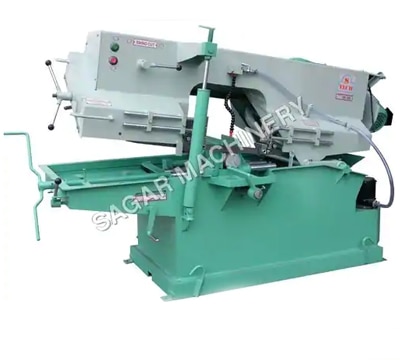 | BAND SAW MACHINE Engaged in offering quality-assured Metal Cutting Bandsaw Machine, we are a well-known supplier and exporter in this domain. View product → |
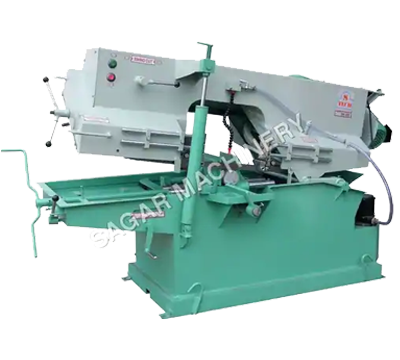 | BAND SAW MACHINE Engaged in offering quality-assured Metal Cutting Bandsaw Machine, we are a well-known supplier and exporter in this domain. View product → |
Frequently asked questions
How do I match a bandsaw to my materials and part sizes?
Start with the hardest material and largest part in your job mix. Check the saw’s rated cutting capacity, blade choice and actual cutting envelope for those parts, including angled cuts and bundled stock.
Which blade and cutting controls should I compare?
Compare variable blade speed, tooth pitch, blade tension and feed control. Choose settings that suit the material, section thickness and required surface finish rather than relying on headline motor power.
What should I inspect on the vice, guides and support system?
Check that the vice clamps squarely, the blade guides are rigid and adjustable, and the support table keeps long or heavy stock level. Misalignment in any of these areas can produce inaccurate cuts.
Should I buy a manual, semi-automatic or automatic bandsaw?
Choose manual operation for varied, low-volume work; semi-automatic operation for repeat batches; and automatic operation when consistent production justifies loading, feeding and cycle controls.
How can I prove a bandsaw before purchase?
Run your own hardest material and largest part through the proposed machine. Check cut time, squareness, finish, blade tracking, clamping and chip removal, then confirm delivery, installation, training and service support.
Related products
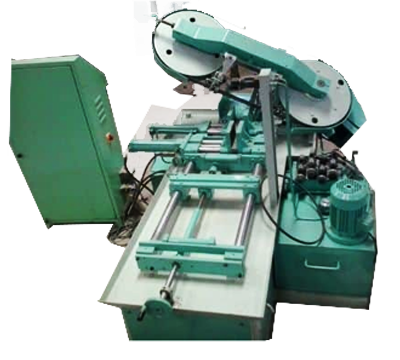 | BAND SAW MACHINE We are catering the increasing demands of our esteemed clients by offering an excellent array of Fully Automatic Metal Cutting Bandsaw Machine. View product → |
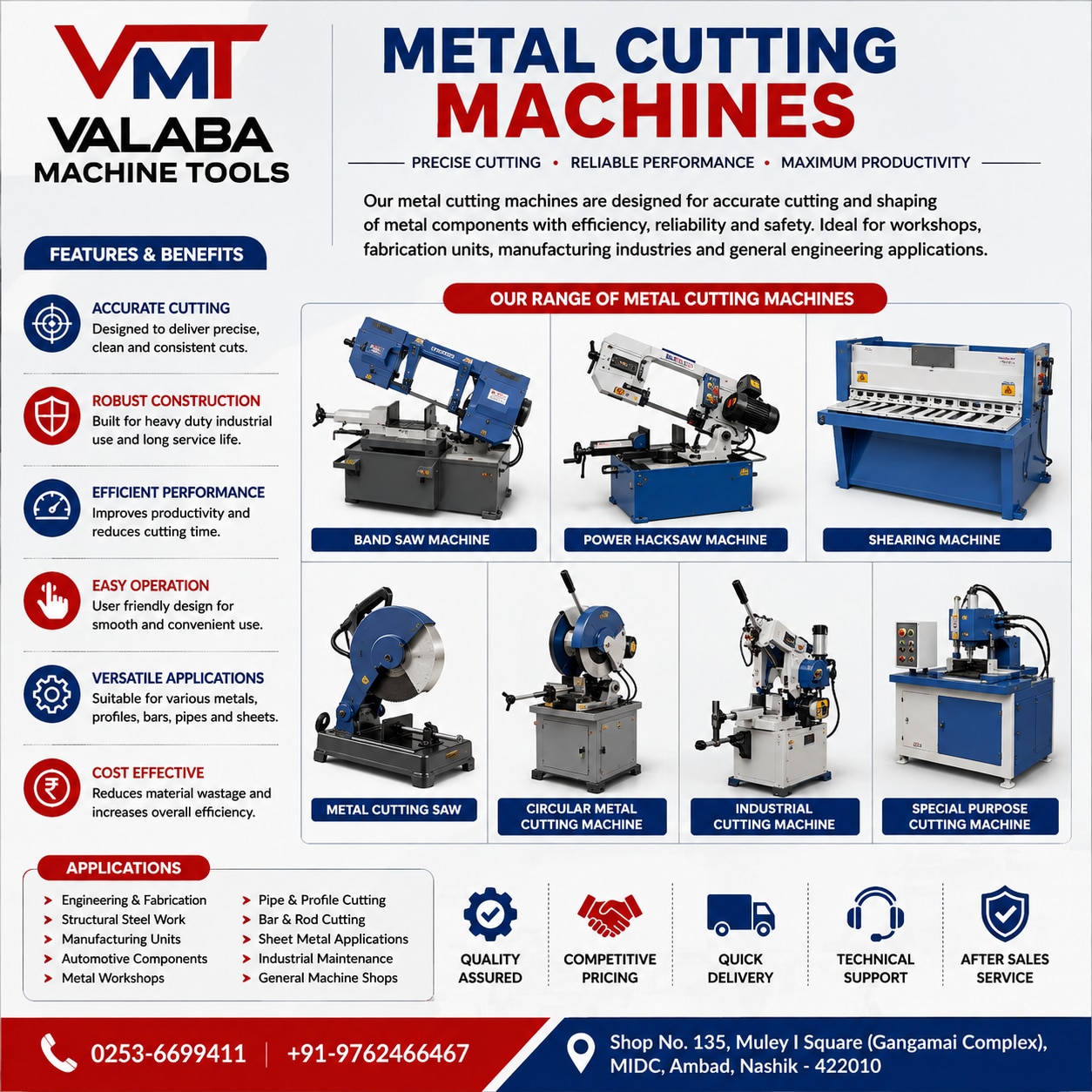 | Metal Cutting Machines are essential industrial machines designed for accurately cutting and shaping metal components according to specific... View product → |
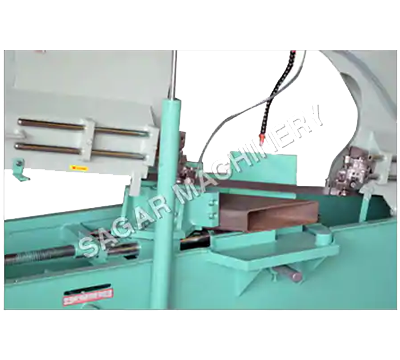 | BAND SAW MACHINE 12” BANDSAW WITH SWIVELING VICE With core competency in this domain, we are instrumental in exporting and supplying a superior assortment of 12” Bandsaw with Swiveling vice... View product → |
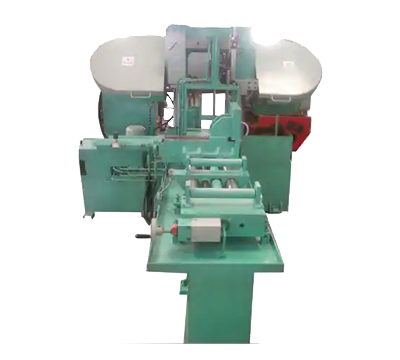 | BAND SAW MACHINE With core competency in this domain, we are instrumental in exporting and supplying a superior assortment of Fully Automatic Double Column Band Saw... View product → |